
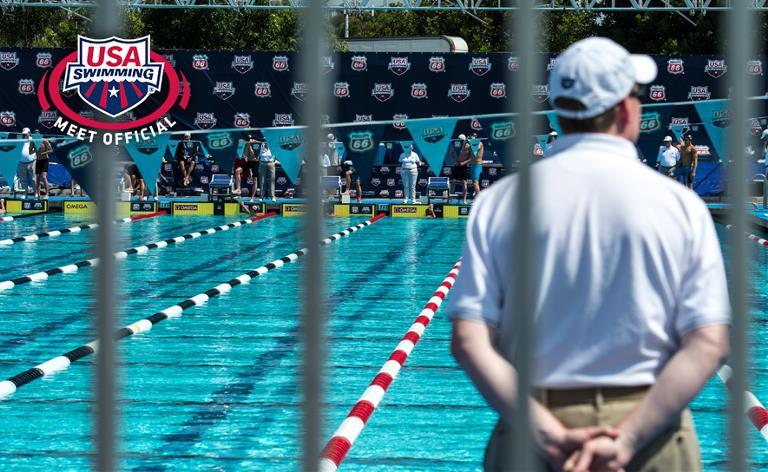


Stroke Judge
The St Charles County Summer Swim League offers a class to teach USA Swimming rules. The league offers these abbreviated stroke judge classes to "certify" officials for SCCSSL swim meets. These certifications are only valid for SCCSSL meets (these classes do NOT certify for USA Swimming or YMCA swimming events), and expire after two seasons. Officials with expired certifications are required to renew by attending another class.
USA Swimming and YMCA certified officials are still required to attend the SCCSSL stroke judge clinic because league modifies/relaxes some rules to accommodate a more relaxed summer league environment. Select this link for the list of SCCSSL league certified officials.
Each team must provide two (2) Stroke Judges each half. Stroke Judges must be certified by completing a league training session. Each stroke judge is responsible for observing the swimmers in his or her quarter of the pool (one-half the width and one-half the length). The Stroke Judges communicate using headset radios.
In the event a swimmer needs to be disqualified (DQ), Stroke Judges should follow this procedure:
- Only DQ a swimmer when you have clearly observed a disqualifying stroke. If you did not see it clearly, it should not be a disqualification. When in doubt, side with the swimmer. Judge only your quadrant and do not point out a disqualifying stroke in another quadrant to another Stroke Judge. If a younger competitor is swimming slowly and is at the end of the pack, do not DQ them. Have mercy!
- Raise your hand upon seeing the disqualifying stroke.
- Communicate over the headset the lane number and the reason for the DQ. For example, say “DQ lane three scissor kick.”
- The Stroke Judge completes the DQ Report (USA Swimming Report)
- The Stroke Judge closest to the swimmer should attempt to provide the swimmer reason for DQ as politely and discretely as possible. This may help the swimmer learn from their mistake; make every attempt not to upset the swimmer as they may have additional events / competition remaining.
- Know the stroke rules and have your booklet with you. If a league representative questions your decision, listen to their opinion and check the rules. If you are wrong, you may change your ruling, but do not take offense. Only the stroke judge that made the ruling may change it. Most league rep’s just want to make sure you understand the swimming disqualification rules, not challenge what you saw.
Disqualification Reasons and Rules: (Abbreviated list)
The technical rules of swimming are designed to provide fair and equitable conditions for competition and to promote uniformity in the sport. Each swimming stroke has specific rules designed to ensure that no swimmer gets an unfair competitive advantage over another swimmer.
Trained officials observe the swimmers during each event to ensure compliance with these technical rules. If a swimmer commits an infraction of the rules that is observed by an official, a disqualification (DQ) will result. This means that the swimmer will not receive an official time and will not be eligible for an award in that event. A disqualification may result from actions such as not getting to the starting blocks on time, performing strokes in an illegal manner, or unsportsmanlike conduct.
DQs are also a result of technical rules violations. They include but are not limited to:
- Freestyle: Walking on the bottom, pulling on the lane rope, not touching the wall on a turn, or not completing the distance.
- Backstroke: Pulling or kicking into the wall once a swimmer has turned passed the vertical onto the breast. Turning onto the breast before touching the wall with the hand at the finish of the race.
- Breaststroke: An illegal kick such as flutter (freestyle), dolphin (butterfly), or scissors (side stroke); not on the breast; alternating movements of the arms; taking two arm strokes or two leg kicks while the head is under water; touching with only one hand at the turns or finish.
- Butterfly: Alternating movements of the arms or legs; pushing the arms forward under instead of over the water surface (underwater recovery); a breaststroke style of kick; touching with only one hand at the turns or finish.
For specific language on any technical rules consult the USA Swimming Rules and Regulations book. There are also some excellent resources located here. The rules require that every reasonable effort be made to notify the swimmer or his coach of the reason for the disqualification. If your child is disqualified in an event, be supportive rather than critical. For beginning swimmers, a disqualification should be treated as a learning experience, not as a punishment. A disqualification alerts the swimmer and coach to what portions of the swimmer's stroke need to be corrected. They should be considered in the same light as an incorrect answer in schoolwork, they point out areas that need further practice. Disqualifications are necessary to keep the competition fair and equitable for all competitors. A supportive attitude on the part of the official, coach, and parent can make a positive situation out of the disqualification.
SCCSWL Certified Officials
- Libbi Simms 2022
- Jamie Rader 2022
- Scott Braswell 2022
- Stacey Bertrand 2022
- Becca McBroom. 2022
- Krista Phillips. 2022